
Research
Adaptation serves as the cornerstone of biological intelligence, shaping the entire cognitive hierarchy from sensation to executive functions. Adaptive decisions lie at the core of this behavioral flexibility, emerging across species through evolution, development, and learning. In the CMC Lab, we investigate the shared and species-specific mechanisms of adaptive decision-making to uncover its underlying computational, biological, and ecological principles.
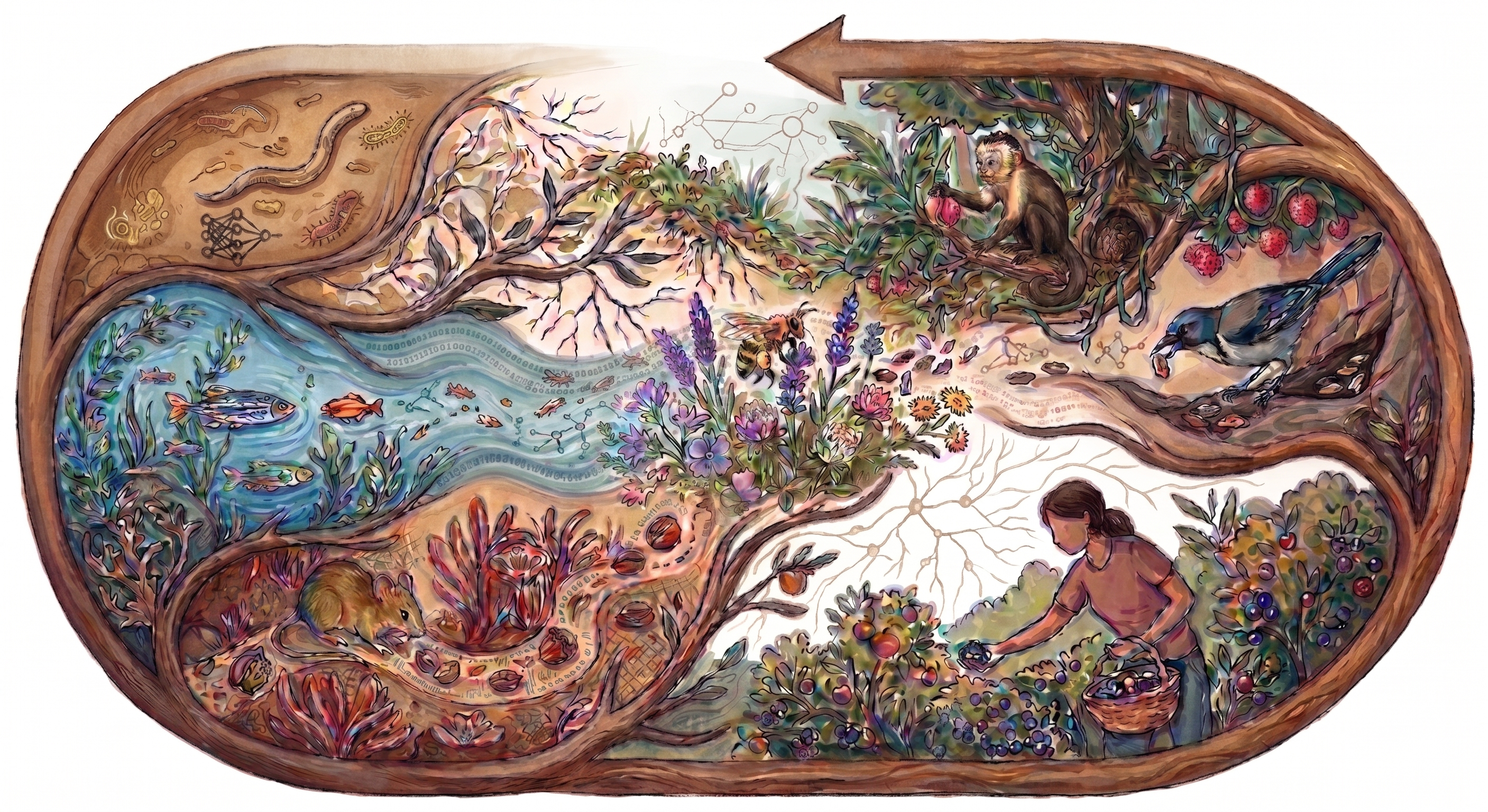
Specifically, we study how adaptive decisions are shaped by three fundamental dimensions: (1) tracking and adapting to a constantly changing external environment, (2) building and updating an internal “world model” to predict future outcomes, and (3) accommodating embodied constraints, which include managing physical sensorimotor limits alongside allostasis, the active balancing of internal energy and physiological needs. Ultimately, survival relies on the brain’s ability to effectively integrate all three dimensions.
To disentangle this complex integration, we combine a vast array of computational methods with analyses of neural and behavioral data. Drawing on methods from reinforcement learning, dynamical systems, and artificial intelligence, we develop testable theories of adaptive decision-making. Then, in close collaboration with various experimental labs, we design theory-driven, comparable tasks across different species, from nematodes and flies to rodents and primates, that are complemented by targeted human experiments conducted in our lab. Relying on this theory-experiment loop, we aim to develop a unifying framework to identify the fundamental principles of adaptive decision-making across species with distinct biological and cognitive constraints and ecological dynamics. Establishing this framework will not only reveal how the interplay between the dynamics of the brain, body, and environment drives adaptive decisions, but also enable us to (a) develop more adaptive artificial intelligence, and (b) better understand maladaptive decisions in psychiatric conditions.
1. Adapting to Environmental Dynamics
Natural environments constantly change across a broad range of timescales, driving continuous fluctuations in vital resources, such as food, water, and shelter, as well as the presence of threats. To survive in these ever-changing environments, animals must learn the dynamics of their surroundings and adapt their decisions accordingly. To study how environmental dynamics shape decision-making, we focus primarily on foraging and defensive behavior, two fundamental processes that naturally depend on these fluctuations. During foraging, animals must constantly navigate the exploration-exploitation tradeoff, deciding whether to utilize a currently depleting resource or leave to search for alternatives. Conversely, defensive behavior involves evaluating and evading environmental threats. Crucially, these processes are deeply intertwined, as an animal must constantly balance the drive to secure essential resources against the urgent need to escape predators. By integrating computational models and analyses of data from cross-species experiments, we aim to map the decision strategies different species use to adapt to environmental dynamics and uncover how these computations emerge from underlying neural circuits.
2. Developing Internal World Models
To make adaptive choices, animals must integrate immediate sensory inputs with an internal representation of their environment. This internal “world model” is built and continuously updated to maximize survival in volatile and uncertain surroundings. We explore how these internal representations guide decision-making across a broad range of contexts, from simple perceptual decision-making to complex foraging and defensive decisions. By using these internal world models, animals can perform mental simulations to predict outcomes, test competing hypotheses, and plan actions in scenarios they have never directly observed. This inferential capability is critical for generalizing to unexpected and highly uncertain environments. Our goal is to uncover the precise computational and neural mechanisms by which different species construct, use, and update these internal representations. To achieve this, we develop predictive computational models and advanced data analysis methods designed to decode and evaluate internal states directly from both behavioral and neural data.
3. Accommodating Embodied Constraints
Decisions do not occur in isolation; they emerge from the continuous, dynamic interplay between the nervous system and the physical body. Here, we investigate how physical embodiment shapes and constrains adaptive decision processes. Specifically, we focus on the roles of allostasis, including internal physiological states like hunger and thirst; sensory limits, which dictate how the body registers information; and biomechanics, which define the range of physical actions. While internal physiological needs actively drive an animal’s goals, its sensory and motor architectures restrict the strategies available to achieve them. To understand how the nervous system and body jointly coordinate behavior, we integrate these physiological and physical variables directly into our computational frameworks. By investigating the embodied aspects of adaptive decision processes, we ultimately aim to build theories of adaptive behavior that accurately reflect the true physical constraints of the natural world.